Your shopping cart
Your shopping cart is empty!


Your shopping cart is empty!
Hey there Gamers! The past few weeks has been a hive of activity here at RGHQ!
Not only have we been prepping for this year's Fighting Fantasy Fest in London, where you'll find among others, the stalwart artist Russ Nicholson (more news on Russ coming soon!); we've been arranging our tables at the Dragonmeet convention later in the year; and all the while adding hundred to our growing range of products!
We've been going back through the years of Magic: The Gathering set by set, adding each card to our database and while we were, we once again found ourselves pondering over set design and just how many cards are in the game of Magic: The Gathering! Recently we added in Core Set 2015, and the entire Khans of Tarkir block.
The artwork and set design for Khans and M15 are so distinctly different it struck me as quite magnificent.
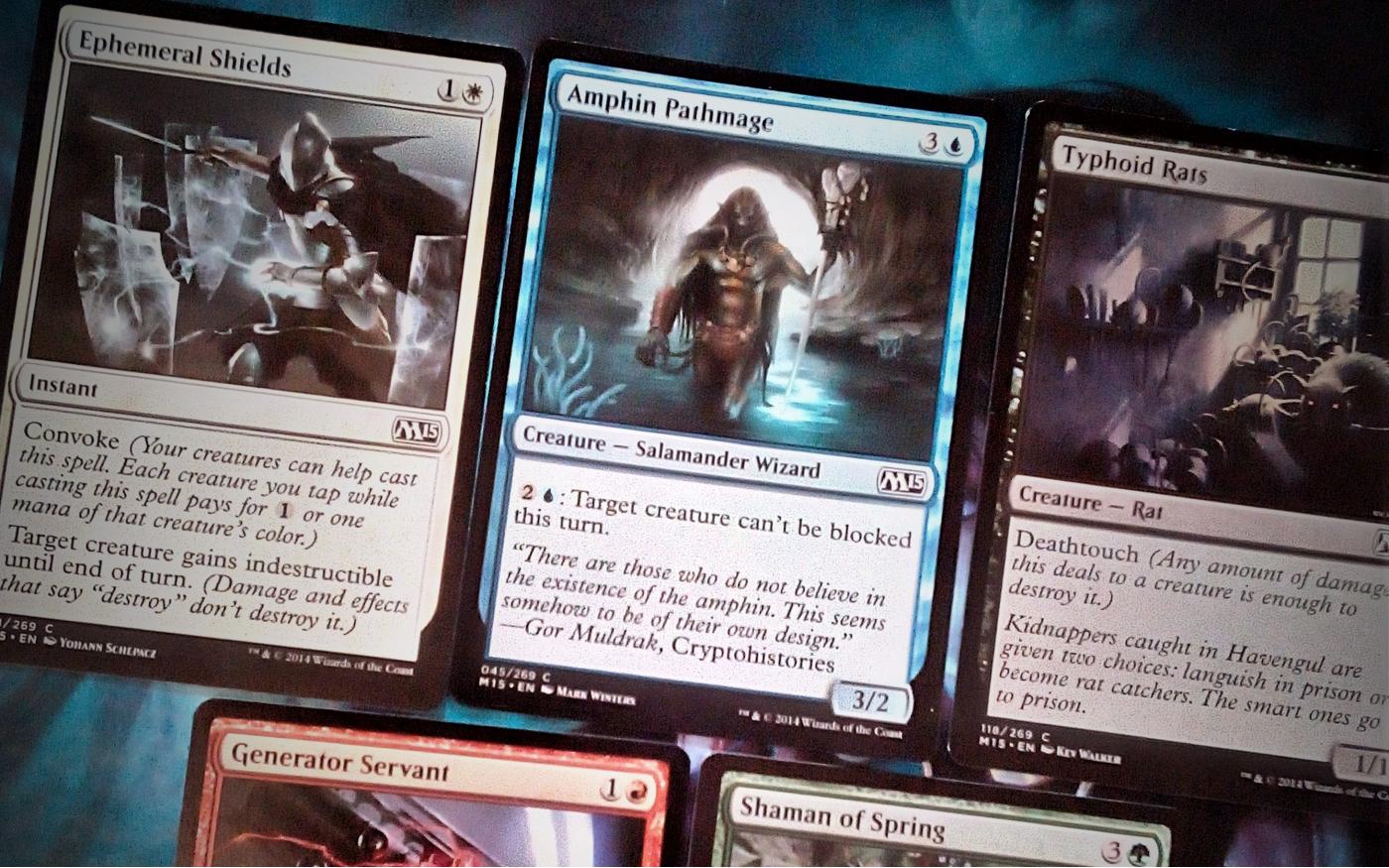
With the Core Sets being at a more introductory level, we find they allow for some basic evergreen cards to be brought into Standard in a steady rotation; cards like Cancel, Lightning Strike, and Mind Rot, all have their home in some decks and sideboards. Some formats even use them as staple cards, and of course being reprinted regularly within a Core Set framework, it helps to keep prices low.
But Core Sets aren't just home to basic and cheap cards. Some of the games most powerful cards have come out of the modern Core Set, some that have warped the entire Standard format. Think back to M10's Baneslayer Angel for example? Or M11's Primeval Titan? Even M14's Archangel of Thune? There's certainly room for powerful card development within the Core Sets, which are of course designed to fit in with current metagame options within the current Standard environment, but sometimes they can provide unique and powerful gameplay options that entire decks rally around.

So what about the Block set design? It's less block nowadays, but we're talking of the theme sets that drive the Magic multiverse narrative forwards. Going through the Khans block as we were listing them on our singles page got me thinking of the fun that Magic's game designers must have had putting these sets together. Take the colour pairings as an example and how defined they now are; I mention "Jeskai Control" and you instantly know the type of deck I mean, and sure you know the type of deck that you'll see from the "Abzan Midrange" player. Think to the cards that we all know and love that have come out of the mill - Tarmogoyf, Thoughtseize, Snapcaster Mage, Monastery Mentor - they are all recognisable, powerful and exciting.
With Block sets, entire archetypes form, mechanics are introduced and powerful combos are explored and discovered (sometimes unintentionally), but what we enjoy most here at RGHQ is the flavor that all interlocks; from card design to mechanics to art direction. Often, it's all in a rather poetic and fluid way that really warms our cockles and something we think should be appreciated a lot more!
But it's not just the excitement of creating new and interesting gameplay, it's also quite the responsibility. Make one card too powerful and you've got yourself another Splinter Twin. Make a particular mechanic OP and you'll have the popularity pendulum constantly swinging one way. It's quite the balancing act and one the design team should be applauded for,
Whatever your niche when it comes to Magic: The Gathering, whether you're the rarity collector, the card alteration fan, the foil pimp or the humble FNM grinder, check out the latest additions to our store and have a look for a new deck style or archetype, a new flavour for a Commander project, or maybe even begin a new format altogether... Pauper is rather fun after all.
Happy gaming!
- Rogue


Let me help you spend some money :)