Your shopping cart
Your shopping cart is empty!


Your shopping cart is empty!
If you don’t know the name Michael Lim, then there is a good chance he is better known to you by his pseudonym, Daarken. His career as an artist began in 2004, when his ‘incessant video game playing’ was interrupted by a phone call. The rest is, effectively, history…
When Lim was younger, he never considered art as a career. “I think a big part of that comes from the negative connotation associated with art as a career,” he began. “Many people don’t think creating art is a ‘real’ career, and definitely not one that can support a family. It was even worse back in the 80s and 90s, so it never really crossed my mind that I could make a career out of drawing things.” But the world has a lot of hidden strings at play, and if we didn’t have creative minds who spent time ‘drawing things’, then our lives would be far less fulfilling.
“Originally I went to college for computer programming,” he continued, “but after a semester I knew this wasn’t what I wanted to do.” It was time to reflect. “I had no idea what I should change my major to, so I tried to think about what other things I enjoyed. I liked drawing, so maybe I could give that a shot.” The next semester he started taking classes that would transfer to an art school, like biology and art history. After his first year at the University of Texas, Austin, Lim transferred to the Academy of Art University in San Francisco. Most days were spent with a sketchbook at a figure drawing workshop or in a café, where he was affectionately known as ‘the guy that likes to draw deltoids’.

After three years of drawing deltoids and playing video games, Daarken graduated with a BFA in traditional illustration. Now, you might still be wondering about that phone call which changed everything…
When that call came, Daarken was on high alert. The mysterious voice on the other end identified himself as someone from Wizards of the Coast, an elite headhunter if you will. With fiery impulse, Daarken blurted out that he wanted to work for them before even hearing about the project. This is the moment that a lifestyle of creating monsters and zombies, with the occasional video game on the side, began.
Daarken, whose name was coined from a purely descriptive trait of his work, began doing interior artwork for Dungeons & Dragons books; From character concept to battle scenes, his work is decisively entrancing. He eventually made the transition to working on Magic: the Gathering because the idea of world building and fantastical creatures cannot be contained, and as such the artwork and aesthetic is transferable between the two.
“Magic: the Gathering is huge, and it’s played all around the world so that’s a lot of pressure to create something good,” he said when I asked if he found the move intimidating. “Dungeons & Dragons wasn’t as big 16 years ago as it is today, so I wasn’t nervous about creating those illustrations. Or maybe I should say it wasn’t as accepted back then. You had to hide the fact that you liked D&D, otherwise people thought you were either satanic or immature for playing a ‘silly game’.”
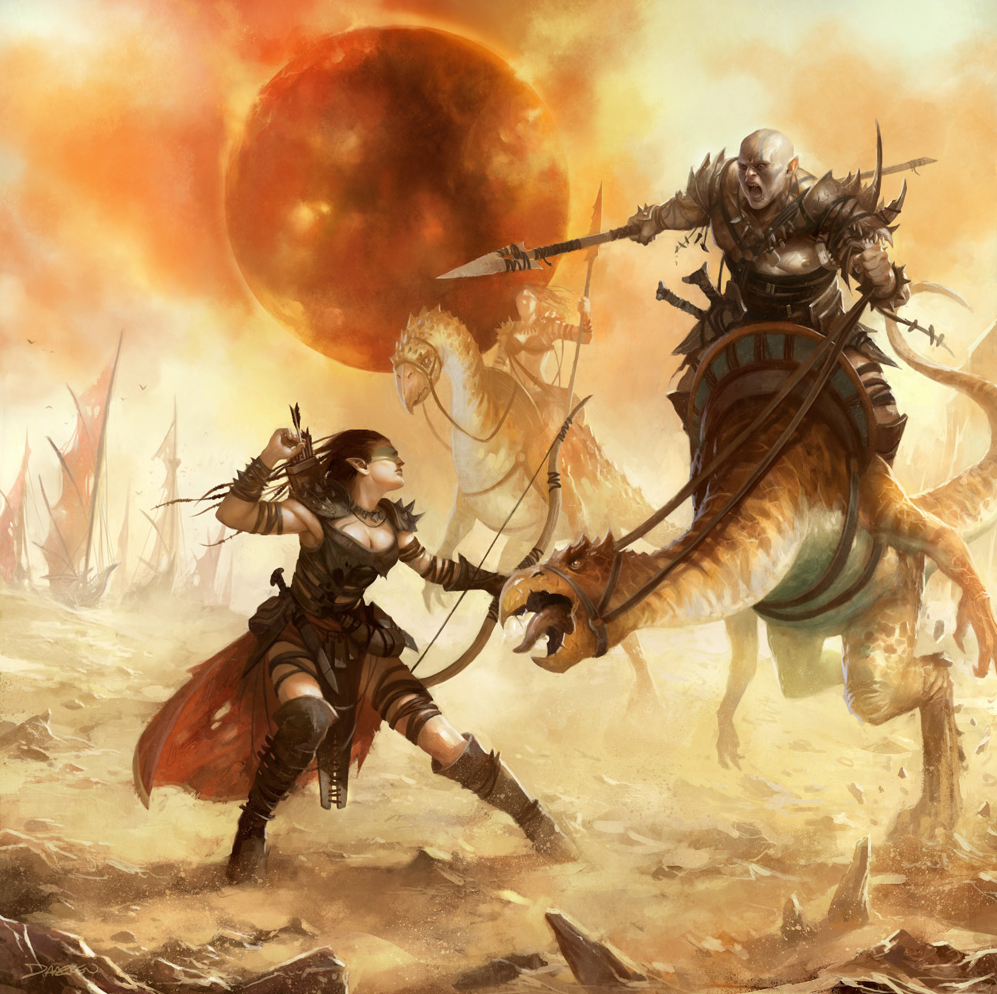
Because artwork leaves a lasting impression on all of us and we find ourselves coming back for more, it’s always interesting to find artists who don’t really like their own work. Daarken is one such artist and tends to ‘hate’ much of his work. We find it’s a response to comparison; “I’m always comparing myself to others. I know you shouldn’t do that, and I tell other people the same things, but it’s hard not to when you see all of the awesome art out there. I’m not a confident person in general, so I tend to automatically default to the ‘I’m not good enough’ mentality. I’ve always loved how loose some artists are, but I can never seem to achieve the same results.”
Despite all of this, Daarken still manages to dive straight into everything he does. Perhaps this is why, unlike many artists, he doesn’t spend every waking moment sketching. There’s less time for self critique.
I asked Daarken how he learnt to work with colour in a way that worked for him. His work has a strong focus on light and dark, which while still fantastical, gives the work depth and a sense of realism. “I’ve always struggled with colour,” he said. “I have a hard time making decisions, so I always start my paintings in black and white. My older paintings were really dark and muddy, mainly because I went too dark with my black and white phase and I didn’t add enough lighter values when I added colour.” At this point, he switched from blocking things in with values and shapes to doing line drawings. “That helped a lot,” he said, “because I didn’t start off with a really dark painting. I also don’t have to rely as much on layer modes like overlay and hard light to add colour. Since I have a line drawing, I can just start painting in straight colour.”
But life goes on and it’s important to adapt to the changing world around you. For an artist, that was predominantly a move into digital art. “It was a necessary change for me,” Daarken added. “Digital painting is just so much faster, and cleaner! It also allows me to work anywhere. I can work on the couch, at a café, on the bed, anywhere. I’m the primary caregiver for my two kids so I need to be able to work anywhere, it’s a little hard to do that with oils.”

In another interview earlier this year, Daarken said it was a ‘weird line to walk’ when it comes to working on new art and creative concepts. Working on these new pieces and to commission can sometimes be a bitter ordeal.
“As long as people have different opinions, no one will ever be fully satisfied with art,” he said when I brought up the challenges of working to a client brief. “There is always someone out there who doesn’t like your work. Your goal isn’t to please everyone, it’s to please as many people as possible while also meeting your client’s needs. You were hired for a job, so you need to fulfil it. That’s one of the hard parts about working with clients and briefs. Sometimes you get a client or brief that doesn’t match what you do, but you are still expected to perform.
On my first day working for Mythic Entertainment on Warhammer Online: Age of Reckoning, I had to create concepts of docks. Architecture isn’t really my strong suit, so I was really thrown into the fire on my first day. It was horrible. I immediately began to question why I was there. I didn’t think I could do it. I put so much pressure on myself to create something cool and show people that I could paint architecture in addition to characters. I felt like hiding my painting whenever someone walked by and I dreaded submitting it for review. In order to grow as an artist, you have to be pushed out of your comfort zone. If you only do what you know you can do, you won’t be able to reach a higher level…”

Wizards of the Coast are, in Daarken’s words, ‘really good about giving the artists freedom’, but everyone has had a client that has micromanaged everything. “Every artist has had someone make them change every single aspect of a painting based on what they wanted to see,” he added. Daarken has also been in situations where he was making upwards of thirty changes to a final. “It really puts a strain on the artist/client relationship, and I’ve declined future work with clients because of this. Most of the time I think my paintings suffer from micromanaging and sometimes a client will make changes to your painting after you give it to them. I’ve had clients change the background, change the colours, even move my characters around and not properly mask them out. That almost always ends up with a subpar painting.”
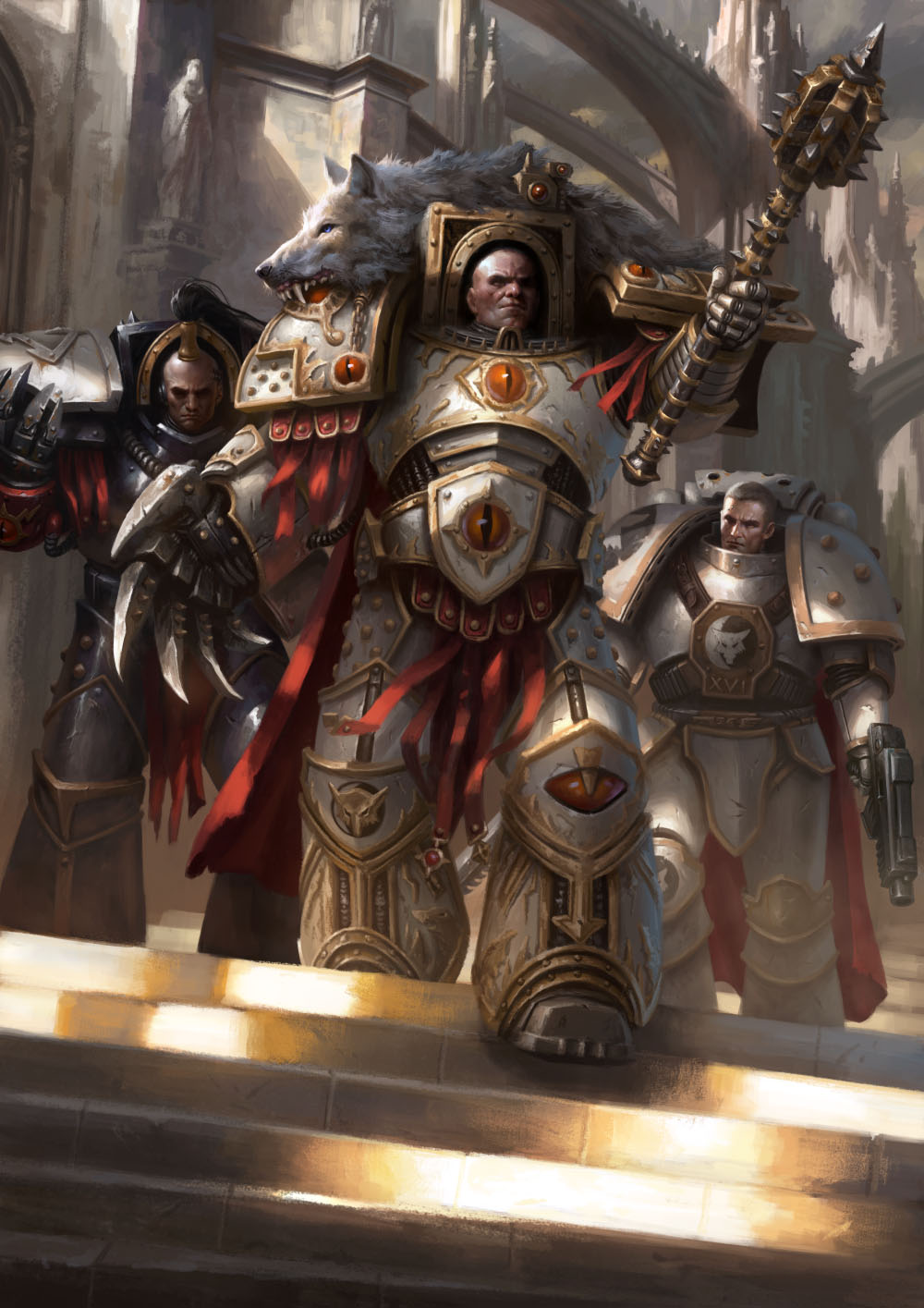
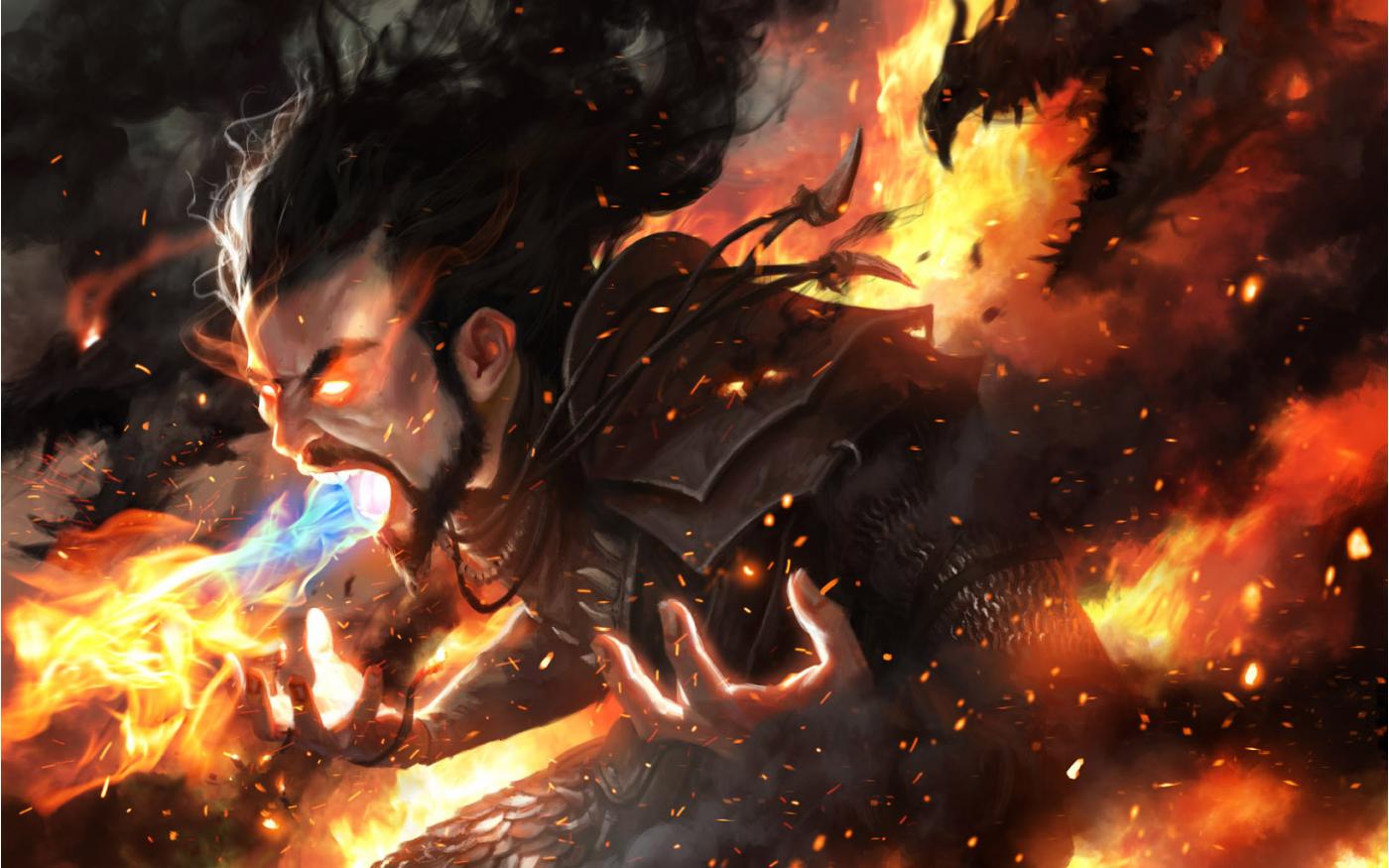
On a similar note, I wondered if Daarken has ever felt like he was creating the same work over and over. While each piece is its own, there is no denying that there are strong similarities throughout his portfolio; Strahd could just as easily have been Mavren Fein, Dark Apostle; Smaug, as illustrated in the piece ‘Bilbo Stealing the Arkenstone’, shares many similarities with the Blood Dragon from The Elder Scrolls: Legends.
“That’s always a challenge,” Daarken admitted, “especially for concept artists. How do you take something like a dwarf or elf, but make it feel fresh and new? How many times can you iterate on that while still maintaining originality. This is an increasing problem with the Magic: the Gathering concept pushes because so many things have already been done. Most artists have certain sensibilities when it comes to design. We tend to reuse the same shape language over and over. I think that’s why working on concept pushes is so great because you can see what the other artists are doing. They have different ideas and that can spark something new in your own designs. Sometimes it’s completely out of our control. The general public often can’t tell the difference between designs, so they think everything is the same. I can’t count how many times fans have thought one of my characters was Sarkhan Vol, even though their outfit and face were completely different. Or that one of your designs is copied from League of Legends or Dota 2, even though they look nothing alike.”
One could assume then that perhaps perception is fleeting and the audience retains only a feeling of familiarity. But the impact of Daarken’s work is still staggering, and though similarities are there even within his own portfolio, they are borne from a common ground. Art goes through phases and can be a direct reaction to everything else going on around it. Pick up any early Games Workshop rule book from the 80s and the line drawings could have been done by the same artist, but they weren’t. We still appreciate them all the same though.
If Daarken hadn’t changed majors and received that call after graduating, do we have reason to believe that his life would have taken a different path? Does Daarken himself know?
“I have no idea!” he said. “I can’t imagine myself sticking with computer programming when I found it so awful. I would probably be miserable.” And that’s it right there folks, don’t do something if it makes you unhappy. Would Daarken tell a young Michael Lim that? “I would say that with hard work and proper marketing/networking it can be done. If it’s something you really want to do, fight for it. The journey may be rough, but something you have to do hard things in order to be happy. I would also tell myself to not argue with art directors! [Laughs]”
You can check out more of Daarken's work here

Let me help you spend some money :)